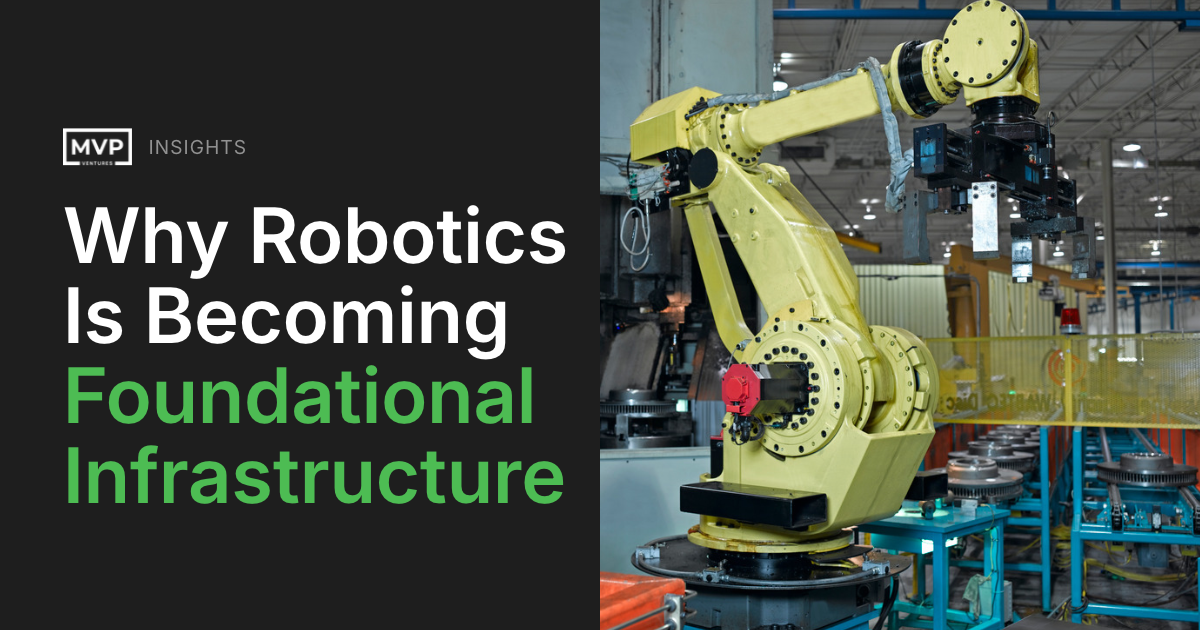
Robots used to be machines that were only highly effective at repetitive tasks in controlled environments. They were too rigid and expensive for most of the physical economy, and largely limited to industries and applications where automation already made sense. AI is changing that.
As AI continues advancing, it’s enabling the deployment of more capable, adaptable, and economical robots. These machines can now perceive their surroundings, make decisions, and perform complex work to a degree that once required human involvement.
While AI is expanding what robots can do, advances in hardware, sensing, and compute are making those capabilities increasingly practical to deploy. At the same time, manufacturers, logistics networks, defense organizations, and infrastructure operators require increased productivity, resilience, and capacity. This convergence of technological capability and industrial demand is quickly moving robotics from specialized technology to a foundational piece of the physical economy.
Where Robotics Is Becoming Foundational Infrastructure
Robotics can change the underlying economics of work across industries:
- In manufacturing, autonomous systems can increase throughput and expand production capacity by operating longer, increasing utilization, and performing work more consistently.
- In logistics, they can continuously move goods through even the most complex supply chains, ensuring they are properly picked, moved, sorted, and routed.
- In defense, they can augment human capabilities while also reducing risk to personnel and enabling new tactics built around autonomy, scale, persistence, and coordination.
- In energy and critical infrastructure, they can inspect, maintain, and operate physical assets with increased scale and consistency.
While the applications differ, the underlying value of greater productivity, precision, safety, and capacity is common across each market. As these capabilities improve, robotics will enable industries to operate and scale in entirely new ways while simultaneously making the supply chains and technologies supporting it cheaper, better, and more widely available.
What Happens When Robotics Scales
As robots further emerge in the market, demand will grow for necessary components like sensors, actuators, servos, motors, and compute. This demand will drive costs down by supporting a deeper supply chain and greater manufacturing scale. Lowering costs makes wider applications of robotics economically viable, in turn, creating more demand and more scale.
An added benefit is that AI can further reinforce this cycle. As the number of robots deployed increases, more opportunities to collect data and improve robotic systems will arise, resulting in more capable robots and an expansion of the range of work they can perform.
This is a cycle we’ve seen before. When smartphones began to scale, GPS, cameras, sensors, and compute became less expensive and more available. These components then went on to enable products and markets beyond the smartphone. Similarly, rare-earth magnets became building blocks for electric vehicles, drones, and robotic servos.
Robotics could follow a similar trajectory. As the underlying technologies become cheaper, better, and more available, they will improve more than just the robots. They will possibly form entirely new products, applications, and markets.
Why We’ve Been Focused on Robotics
Robotics companies have already raised more venture capital in 2026 than all of 2025, but at MVP Ventures, our focus on robotics predates this recent spike.
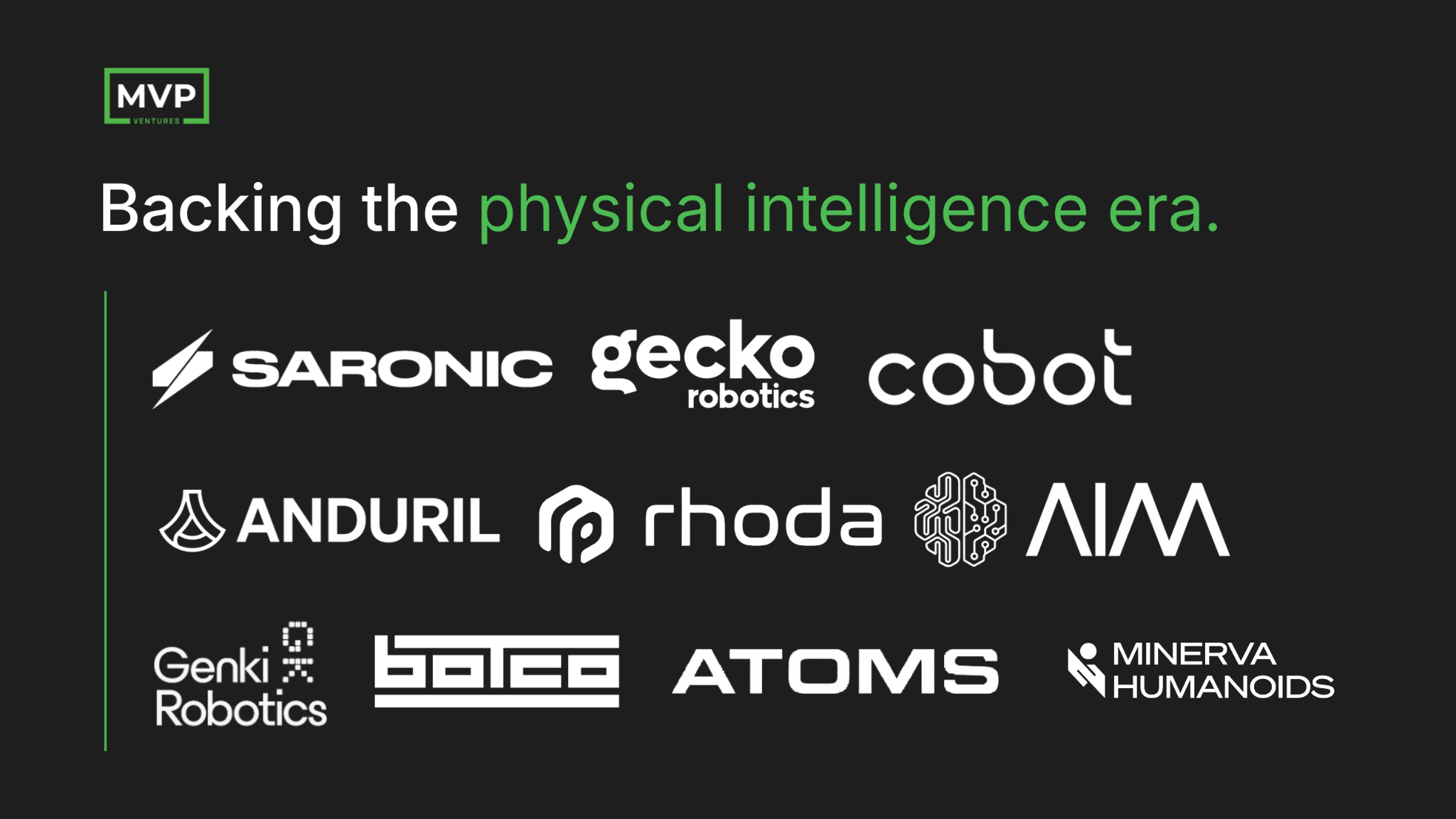
A large part of MVP Ventures’ investment approach has always focused on the intersection of AI, hardware, and software. Robotics is one of the clearest examples of this thesis. It brings intelligence out of digital environments and applies it to the physical economy, and we’re seeing this occur across our portfolio.
- Collaborative Robotics is focused on building a new generation of robotic systems designed to operate alongside people in real-world situations through its robotic systems and its Flywheel program.
- Gecko Robotics was one of our earlier robotics investments in 2022. Using robotics, sensors, and AI, the company collects high-fidelity data from physical assets that often operate in harsh environments across energy, manufacturing, and defense.
- Rhoda AI develops general-purpose robotic intelligence. It is designed to adapt to the unpredictability of real-world industrial environments, such as manufacturing and logistics.
- AIM Intelligent Machines takes existing heavy equipment and turns it into autonomous fleets that help mining and construction operators to increase output, utilization, and safety.
- Genki Robotics is developing intelligent humanoid robots for practical use in areas like public safety and urban maintenance.
- The Bot Company is introducing robotics into the consumer market by building robots designed to take on everyday tasks at home.
- Anduril and Saronic move robotics into the defense industry, showcasing that autonomy can increase scale and persistence, reduce personnel risk, and enable new operating models.
- Atoms’ approach is building companies around physical automation across industries including mining and food.
- Minerva Humanoids is a robotics company building humanoid robots for the world’s most dangerous jobs in onshore and offshore oil and gas operations and public safety.
While their applications vary across each of these companies, they reflect the same underlying shift, showcasing that increasingly capable autonomous systems are moving into more parts of the physical economy.
The Bigger Opportunity
AI has expanded what machines understand and decide, and robotics has brought that intelligence into the physical world, translating it into measurable productivity and capacity gains.
As the range of work robots can do expands, so does the scale of opportunity. The big question is no longer how big the robotics market can become, but how much of the physical economy can be automated, and how differently industries can operate when work is no longer constrained in the same ways. This question is particularly relevant to American manufacturing.
Robotics has the potential to reduce the labor intensity of manufacturing to increase throughput and allow domestic facilities to compete with production models that have lower labor costs. The chances are increasingly tilting toward automation as labor costs rise and advances in AI, hardware, and manufacturing make robotics more capable and economical to deploy. Automation is becoming essential to making reshoring economically viable at scale.
A fundamentally more productive physical economy can be built upon robotics, making it one of the technologies that makes rebuilding America’s industrial capacity possible.
Want to learn more about how we back founders early and deliver after the check clears?
Explore what makes partnering with MVP a no-brainer: mvp-vc.com | LinkedIn | X